
The IOC is asking tougher questions about the value each sport brings to the Games: audience demand, global relevance, visibility, cost, sustainability and product strength. Olympic inclusion can no longer be treated as inherited protection. It has to be earned.
At the same time, the sports market has become much more competitive. New properties are being built with simpler products, clearer athlete stories, stronger year-round promotion and a sharper feel for casual audiences.
That is the squeeze – pressure from above and pressure from the market.
IFs own many of the things that make sport matter: rules, rankings, pathways, world titles, Olympic connection and global governance. But those assets only become commercially useful when they create demand.
The risk is not that IFs disappear; they will still run the sport. The risk is that they are only the infrastructure: essential to the system, but less competitive in the fight for attention and demand and ultimately commercial value.
Their official status is no longer enough; the properties that win are the ones that make people choose to watch, follow, share and buy into the sport.
The first headwind: the IOC is raising the bar for Olympic sports
The IOC wants the Games to keep growing as a global product.
At the centre is the Olympic programme itself: what each discipline contributes to:
- relevance (sport/health)
- audience demand
- visibility
- global appeal (especially youth)
- cost efficiency
- product strength
- broadcast value
- the overall Games experience
That matters because Olympic inclusion has protected some sports from normal market pressure. The Games give them context, jeopardy, national relevance and scale. Outside those two weeks, the market is far less forgiving.
It’s not down to a failure of effort. Federations operate with constraints private leagues often don’t, like membership structures, technical rules, athlete pathways, Olympic obligations, small budgets and the need to serve both mature and developing markets. However, those constraints make clear positioning more important, not less.
There is, of course, a strong argument that the breadth of Olympic sport is part of what makes the Games so valuable.
If disciplines are now assessed against relevance, cost, visibility and commercial impact, IFs can no longer assume Olympic inclusion is inherited. They have to prove that their sport strengthens the wider product.
Other markets show what can happen when incumbents own the infrastructure but lose the consumer relationship. Taxi companies had licences and local scale, but Uber captured the user experience. Newspapers had distribution and classifieds, but digital platforms captured attention and advertising value. The incumbent did not disappear; the value just got moved.
The Olympic Games hide a weak demand problem because the Olympic brand is the ultimate cultural wrapper, and outside the Olympic window, IFs have to create more of that demand themselves.
The second headwind: the market has moved faster than the Federation model
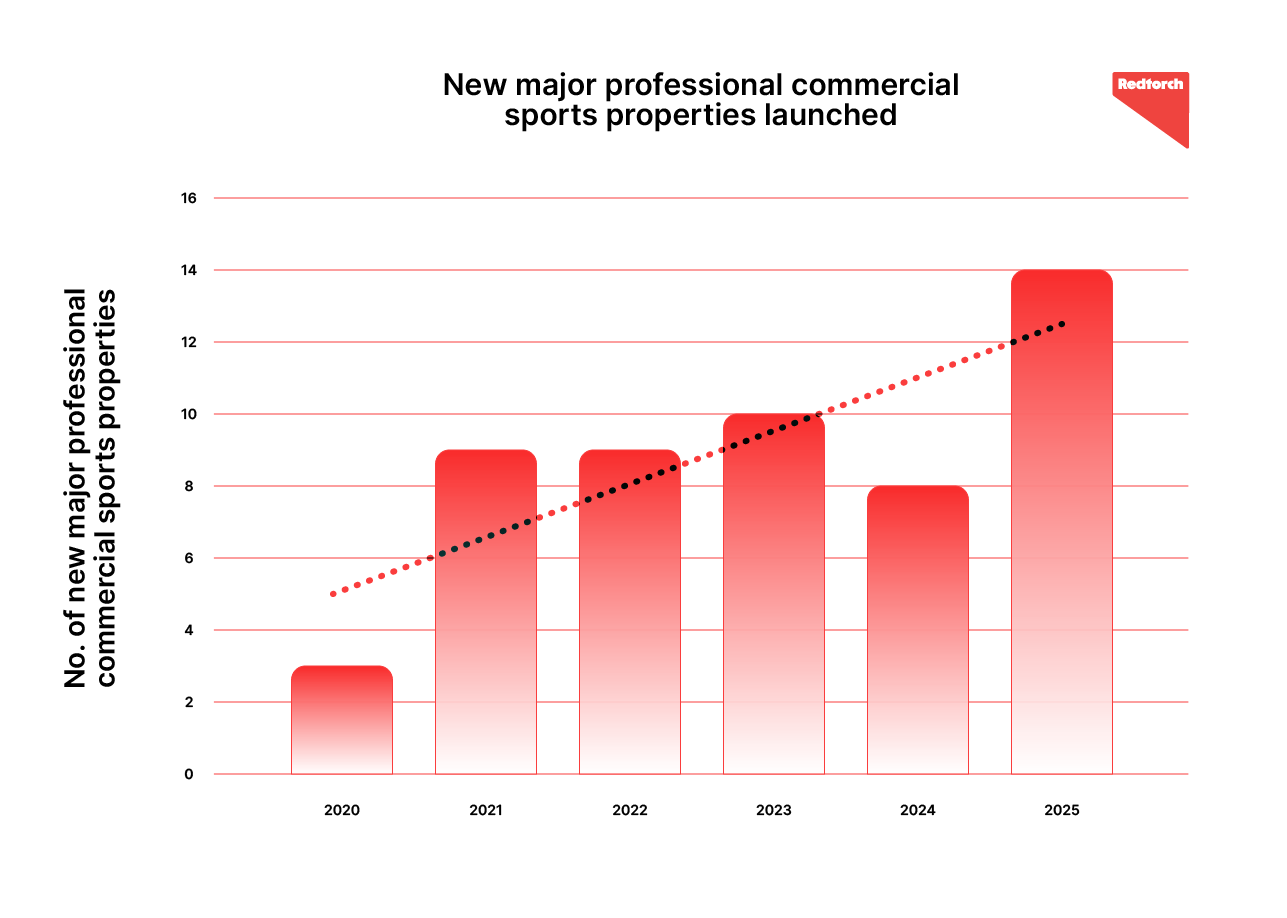
Olympic sports compete in a market where new sports properties are being launched at pace. Based on our estimates, the number of new major professional commercial sports properties launched globally each year was around 4.7x higher in 2025 than in 2020.
Many are privately led and not just adding more events to the calendar. They arrive with clearer products, stronger personalities, simpler formats and a better understanding of casual audiences.
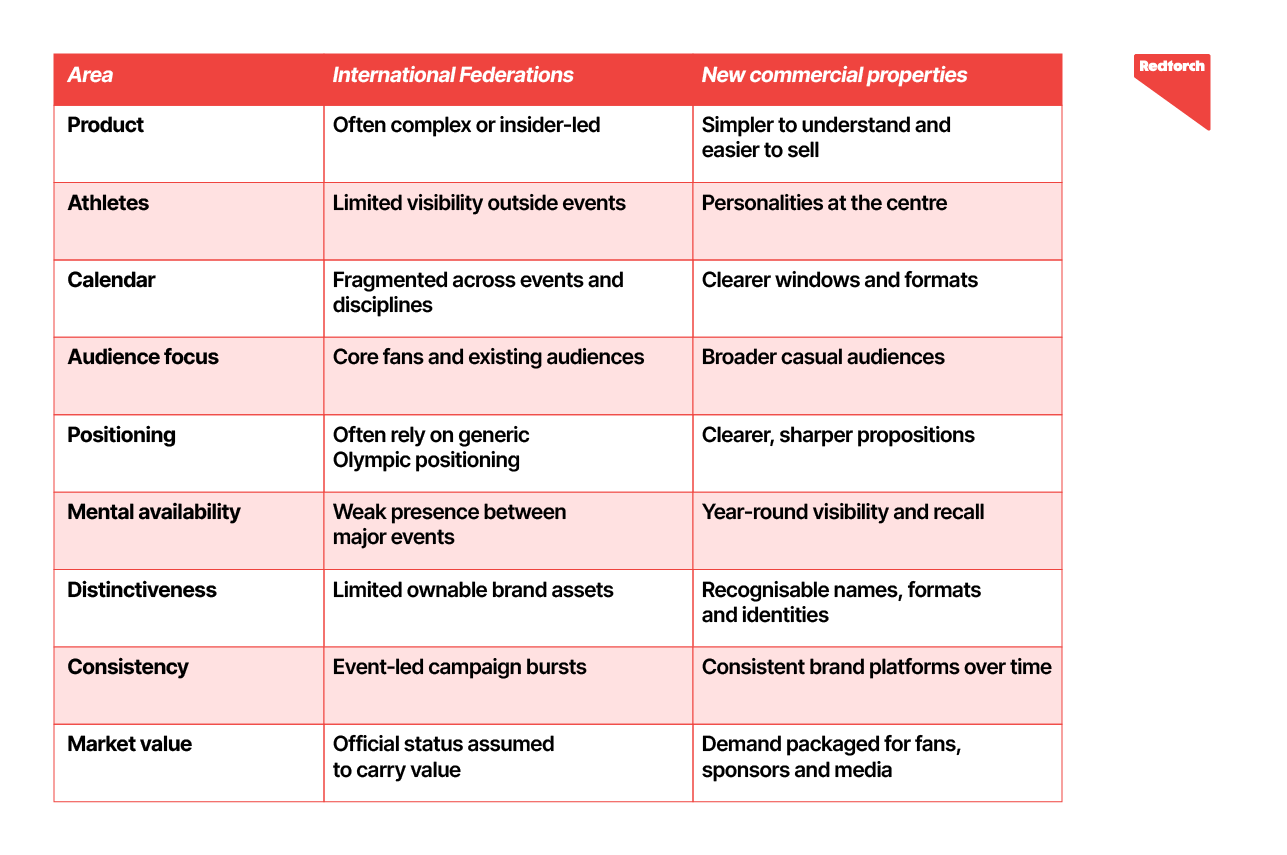
In that environment many IF products look exposed. Their calendars are often fragmented. Their athletes are not always visible enough; the formats can be difficult to understand and the brands can go quiet outside major events.
The contrast is not that every new property is better run than every IF, and of course many will fail. What we see is that they often expose the same set of weaknesses in traditional federation-led sport.
A Olympic-sport-event ad illustrates the challenge. The offer was clear; the event was free to watch. The call to action was simple. There was nothing technically wrong with it. But the message felt interchangeable. “Olympic champions”, “world-class racing” and “Road to LA28” all create credibility, but almost every Olympic federation can claim something similar.
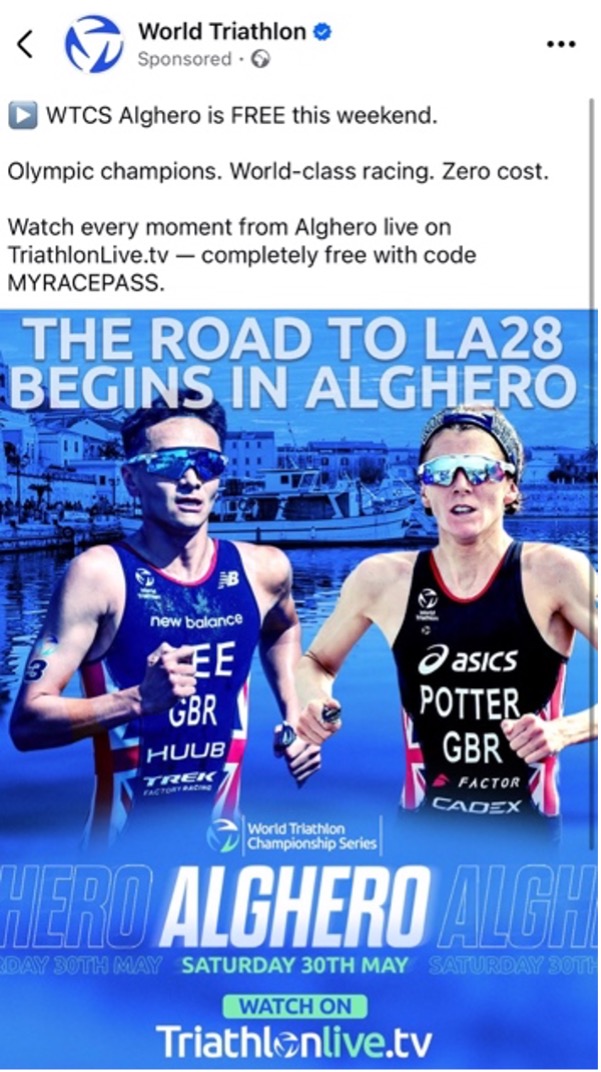
That is the problem: the ad communicated the event, but it did not make triathlon feel specific, urgent or hard to ignore. The strongest message was unlikely to be the fact that it was free.
It was more likely to sit in what makes triathlon different: three disciplines, transition jeopardy, endurance under pressure and the possibility that one mistake can unravel an Olympic campaign.
So what can IFs do?
These two headwinds are now colliding.
From one side, the IOC is pressuring sports to prove their contribution to the Olympic product. From the other, the wider market is rewarding properties that create clearer, more distinctive and more commercially attractive products.
Caught in the middle are International Federations, with legitimacy, history, athletes, events and governance authority, but too often without the products and brands to match.
The answer is not simple, and the same advice is now heard everywhere: tell better stories, be more athlete-led, think like a media company. None of this is wrong, but it is so widely repeated that it has become a generic prescription.
We saw this reflected in SportOnSocial, where commercial sports properties consistently outperformed International Federations. That was not simply because they posted more content. It was because they tended to have clearer products, stronger personalities and a better understanding of casual audiences.
The more fundamental issue is that many federations do not yet have a clear enough understanding of which parts of their sport are actually valuable to consumers.
This is a communications challenge, of course, but it’s a product and brand challenge too.
The strategic question of “What should we communicate?” leaks into “What do we own that creates demand?”
At Redtorch, we believe this is where the opportunity now sits. Not in producing more content or repeating generic advice about storytelling and fan engagement, but in helping sports answer the following questions.
- What moments do audiences care about?
- Which formats are easiest to engage with?
- Which brand positions build the greatest long-term value?
They do not need to abandon what makes them legitimate. The priority now is to move faster, become more distinctive and turn that untapped value into real demand before the market shifts around them.