


International Federations (IFs) have benefitted from a relatively forgiving phase of social media growth over the past decade.
Being present on platforms as they expanded globally was often enough for IFs to increase their growth. Many were able to build substantial audiences (alongside the periodic surge of attention during the Olympics) without having to answer a challenging strategic question: Were they creating demand, or simply benefitting from market growth?
A decade of SportOnSocial (SoS) data suggests that this easier growth phase has ended. The conditions that helped IFs scale are diminishing and the coming era will be far more competitive.
The penetration ceiling is in sight
IFs have significantly expanded their digital footprint during the last ten years: Facebook penetration has risen from 4% of platform to over 6% in 2025; Instagram has grown from 2% to 5%. Even TikTok, the late arrival, has reached about3.5% penetration. Although on paper Olympic sports are increasingly visible in the social ecosystem, they appear to be approaching a 5–6% ceiling.
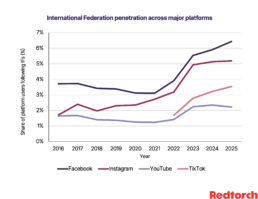
The more important message from the SoS data is that growth is slowing. Penetration curves are flattening across Facebook, Instagram and YouTube. And although TikTok still offers some headroom, the broader pattern is clear: IFs are nearing a natural ceiling on the major platforms. This in itself changes the challenge.
Success in the next decade will not be won by those sports that are merely present. It will be won by those that are distinctive.
IFs have typically expanded with the market rather than ahead of it
The numbers tell a somewhat uncomfortable story about brand strength. IFs achieved an average annual audience growth of approximately 13% in the last ten years. This might sound healthy until it is set against the broader market where global social media usage grew by 10% per year during the same period.
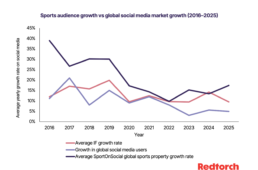
In other words, much IF growth has tracked the expansion of the market itself.
By comparison, leading commercial sports properties have seen a materially different annual growth curve of around 21%. As well as taking advantage of higher platform demand, these organisations are building stronger mental availability. The result? They come to the minds of more people, more often and in more contexts, regardless of whether a specific event is occurring.
It is here that the real gap lies.
SoS data also shows that IFs still struggle to maintain day-to-day relevance outside tentpole moments. They perform well on social during an event, but tend to lose momentum in the extended periods between peaks.
If your growth curve essentially mirrors the platform’s growth curve, you may be relying on a distribution tactic without having a strong brand strategy.
The issue is positioning rather than content supply
One of the most striking SoS findings is that IFs have become highly active publishers, currently producing an average of 11–15 posts per day compared with the roughly 4–8 posts per day from the wider commercial benchmark group(Global Sports Properties 2026 benchmark).
This is significant. Although IFs have built the publishing systems required to maintain constant presence at scale, volume is too often mistaken for marketing and brand strength.
The assumption is that frequent and additional content, published across as many platforms as possible, will naturally strengthen demand. If activity keeps rising while growth slows, however, the limiting factor is no longer content supplybut brand distinctiveness.
The challenge is not for IFs to fill feeds more efficiently. It is how to occupy a clearer, more memorable space in people’s minds.
Don’t mistake efficiency for effectiveness
Nevertheless, there is a genuinely encouraging signal in the engagement data area where IFs have improved their efficiency over time. Average engagement rate per post has risen from c. 0.06% in 2016 to 0.11% in 2025, peaking at 0.13% in 2023/24. Meanwhile, the wider benchmark group average engagement rate declined from 0.40% to 0.18%.
IFs have typically expanded with the market rather than ahead of it
The numbers tell a somewhat uncomfortable story about brand strength. IFs achieved an average annual audience growth of approximately 13% in the last ten years. This might sound healthy until it is set against the broader market where global social media usage grew by 10% per year during the same period.
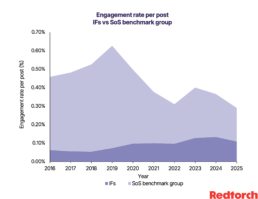
This matters. It indicates that IFs are getting better at converting visibility into interaction. They are becoming more responsive, more effective and more sophisticated in their use of social content. It’s important that senior marketers are disciplined here and remember that efficiency and effectiveness are not the same thing.
For example, if an IF has to post fifteen times a day to sustain a 0.11% engagement rate, while a commercial property delivers stronger returns with half the output, then the issue is salience (how easily people think of you at the right moment) rather than productivity alone. High-frequency posting may support short-term visibility; it doesn’t always build long-term memory structures.
A constant stream of content can create noise without building equity. So, if IFs are becoming better at publishing, they are not automatically becoming stronger brands.
YouTube: a notable strategic blind spot
The largest persistent gap in the SoS audit is YouTube, where IF penetration sits at roughly 2%.
For any senior marketer, this should raise concern. YouTube is the world’s most powerful long-form video environment and an extremely most important search and discovery platform in the digital ecosystem. It is where deeper interest, stronger viewing habits and immersive storytelling can be built.
Many IFs remain lightweight in this maturing market where depth matters. If TikTok and Instagram help drive reach, YouTube can help build stronger audience gravity.
It’s a strategic weakness to ignore the opportunity YouTube offers.
The next step: move from content managers to brand builders
IFs must make the harder choices that strong marketing demands: What does your sport stand for? Who is it actually for? What will you choose not to do? This means moving beyond coverage and consistency towards a brand system that can sustain relevance between major event cycles.
IFs that pull ahead will be those that stop acting like content managers and start acting like brand builders.
They will then be able to:
- strengthen their distinctive assets so their sport is instantly recognisable
- prioritise salience (how easily people think of you at the right moment) above frequency
- focus less on constant output and more on content that genuinely shifts perception
- work harder to own the “in-between” periods by building narratives, formats and reasons for followers to return throughout the year
SoS data demonstrates that IFs have built real presence to be in the room. But in a saturated attention economy, presence is no longer the prize.
The winners will not be those who publish the most.
They will be the ones remembered most clearly.