


The SportOnSocial Global Sports Properties 2026 Report uses our proprietary SportOnSocial tools to monitor and analyse global search behaviour. This enables us to understand where attention is increasing, where it is fragmenting, and where future value is likely to be concentrated.
SportOnSocial doesn’t depend on sentiment or surface-level metrics. Instead, it reveals how audiences actively seek to engage with sport in real time. While the global sports landscape is still growing, it is far more uneven, volatile and competitive than many rights holders anticipate.
Understanding the ways fans find, prioritise and engage with sport is no longer a nice-to-have. It is fundamental to protecting mental availability, demand and long-term value.
These five key takeaways from the report will undoubtedly influence the future of global sports properties.
1. Growth is becoming more uneven & less predictable
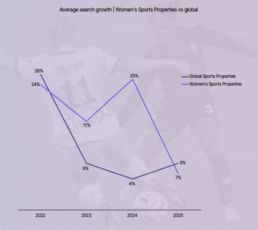
Although the sports landscape is expanding overall, SportOnSocial data indicates that this growth is not evenly distributed. The performance disparities between sports, formats and properties are getting wider, creating a more fragile attention economy where brand salience is harder to maintain.
Volatility is most apparent in men’s sport. Search behaviour in 2025 demonstrates significant swings shaped by factors such as attention dilution and category saturation. Currently, many men’s sports properties contribute to overall market instability rather than the delivery of steady expansion.
Women’s sports properties, on the other hand, continues to deliver the most reliable growth across the sports ecosystem. In 2025, 11 of the 14 major women’s properties tracked recorded positive year-on-year growth, which helped stabilise the broader market as men’s sport flattened.
What does this mean for rights holders?
Predictability is a strategic asset. Rights holders must move beyond “topline reach” and understand the quality and resilience of audience attention. Stability in search demand is a key indicator of long-term commercial health.
2. Growth engine to stabilising force: a shift in women’s sport
Women’s sport continues to dominate global rankings, but the most important signal is not rapid spikes in attention but ongoing momentum.
SportOnSocial data shows that women’s properties benefit from clearer narratives, more accessible competitions and stronger continuity across seasons. They are building Distinctive Brand Assets that foster repeat interest rather than short-term curiosity.
What does this mean for rights holders?
Women’s sport should be embedded into long-term planning, not treated as a peripheral initiative. Investment in scheduling, broadcast stability and competitive depth is essential for physical availability, making the sport easier to find and consume.
3. Innovative formats are earning premium attention
One of the clearest SportOnSocial messages is the growing premium placed on innovation.
Properties that feature distinct formats, simplified narratives and digital-first approaches are outperforming more established competitors in terms of search growth. The FIA World Endurance Championship, for example, recorded search growth of over 100%; Ultimate Tennis Showdown grew by more than 80%. These figures demonstrate how alternative formats can accelerate discovery and market penetration.
Combat sports continue to consolidate attention rather than fragment it. Organisations like One Championship and UFC benefit from year-round relevance, clear storytelling and global accessibility, allowing them to capture a disproportionate share of the audience.
What does this mean for rights holders?
Innovation should be considered a structural strategy, not a campaign idea. SportOnSocial shows that audiences actively look for formats that feel modern, accessible and easy to follow. Properties that fail to evolve their product risk a gradual erosion of relevance and, with it, market share.
4. Increasing pressure on football’s traditional hierarchy
Football remains the world’s most searched-for sport, but SportOnSocial insights indicate that audience attention is becoming more selective.
Europe’s largest men’s leagues are fighting for attention amongst women’s competitions, challenger leagues and alternative formats. High-cost rights models, fragmented access and generational fatigue all contribute to slowing growth for some legacy properties.
At the same time, growth is focused around competitions that merge global platforms, strong storytelling and star access. Those lacking these pillars struggle to maintain momentum in a fragmented media landscape.
What does this mean for rights holders?
The next phase of football audience growth will be defined by consolidation over expansion. Simplifying access, strengthening narratives, and aligning with how fans search for and consume sport is crucial for sustaining long-term value.
5. How fans signal interest is changing faster than most organisations are tracking
This is the main insight from the SportOnSocial Global Sports Properties 2026 report. SportOnSocial is embedded within Redtorch because it allows us to shift from mere opinion to evidence-led decision-making. It helps rights holders, federations and Olympic organisations identify where attention is building, where it is weakening, and how to respond before value is lost.
This is research built inform strategy, commercial planning and long-term investment.
The sports properties that come out on top will be those that treat attention as a moving target.